CHALLENGE: Creating space for seniors impacted by the Palisades Fire to process trauma, reduce isolation, and reconnect with hope and purpose in their recovery.
OUTCOME: Cards for Calamity transformed a monthly senior lunch into a powerful forum for trauma education, emotional release, peer support, and collective healing — restoring connection and hope at a critical time.
THANKS TO: Made possible in collaboration with the Los Angeles Region Community Recovery Organization, Global Empowerment Mission, and Good360.
In year two following the devastating Palisades Fire in Los Angeles, the losses remain layered and heavy. Homes were destroyed. Businesses shuttered. Families displaced. But the deeper disruption is harder to see: fractured routines, broken social networks, and a lingering emotional toll that many carry quietly.
For seniors, the stakes are particularly profound.
Many have lost not only homes, but the energy, finances, and time horizon required to “fight the fight” of rebuilding. As Jessica Rogers of the Pali Long Term Recovery Group shared:
“Most of the people in that room… they’re not going to be coming home. They’re the ones who lost the most. They just don’t have the five-to-ten years to fight. They don’t have the energy. They don’t have the money. In the past year, our community has lost more seniors than usual. Maintaining their physical and emotional health is critical — so they do not lose everything."
In February 2026, more than 150 seniors gathered for what would become a turning point. Pali LTRG hosts monthly senior lunches. The first two were resource-focused and well received. But this time was different.
Instead of focusing primarily on services and giveaways, this event centered on trauma education and collective processing. Jolie Wills from Hummingly delivered a 15–20 minute presentation explaining what happens in the brain and body after disaster, normalizing emotional responses, and introducing the concept of traumatic growth.
Jessica, a geriatric social worker, described the impact:
“This is a critical time for us in the community. People really need this right now. When Jolie put it in context and told people it’s really okay to be having these feelings — whatever range of emotions they’re having — it’s just different. She named it. She called it out. She made it totally okay.”
Even for her personally: “When I heard Jolie speak, it was like a major weight lifted off of me. I had context to put my feelings in.” That context created permission.
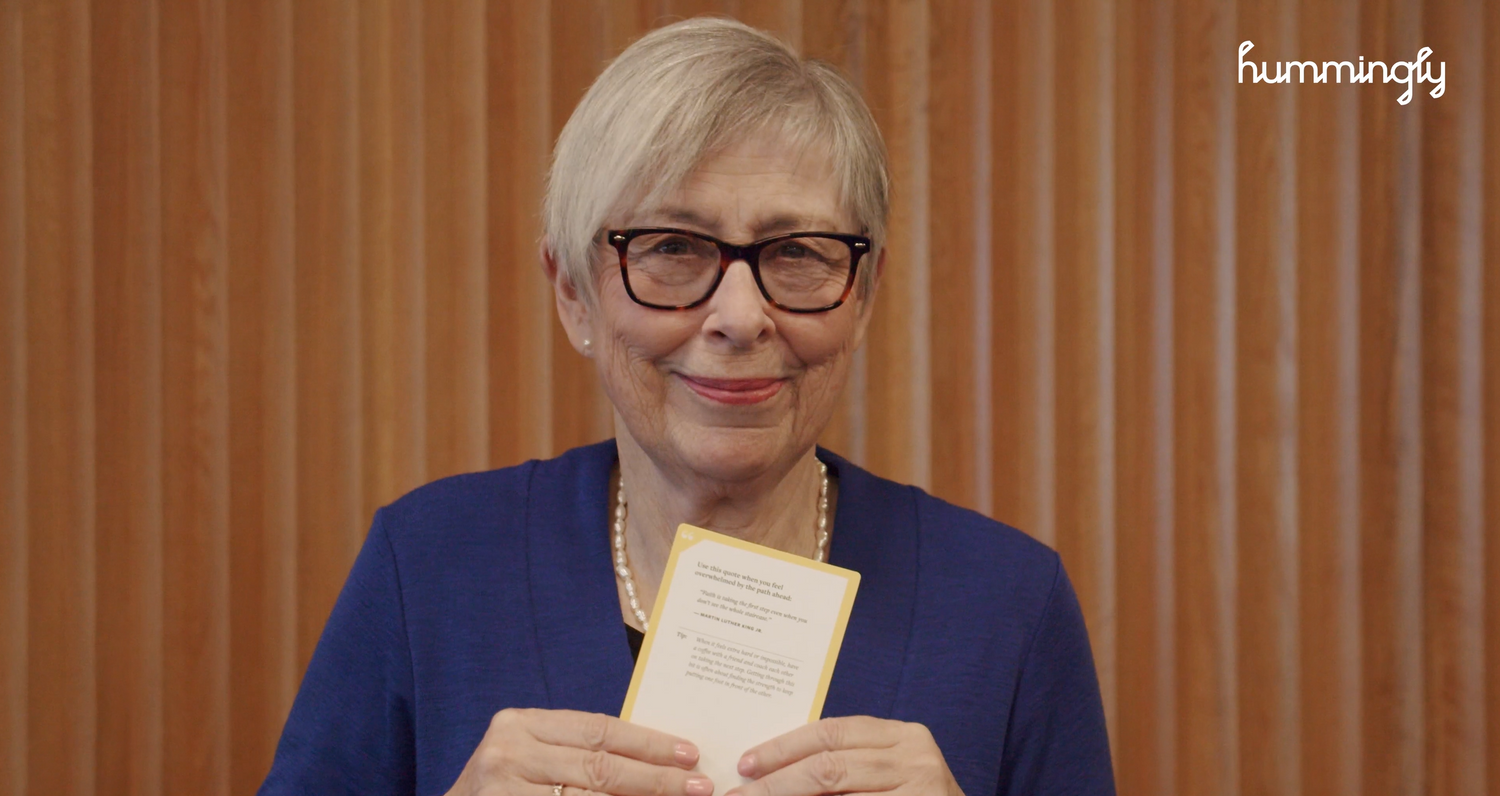
Then came the Cards for Calamity.
Tables were set. Food was served. Volunteers facilitated as active listeners. What unfolded was something Pali LTRG had not seen before.
“This time they were openly talking,” Jessica said. “The Hummingly cards really work because it gets people in touch with their feelings and gives them an opportunity to speak out loud and voice them.”

She watched which cards seniors were “snatching up,” seeing a real-time emotional map of the community. One card in particular — completion anxiety — stood out.
“This helps us understand what is top of mind for the seniors in the room. But it also made me realize… you’re not alone, Jess. I’ve never had anxiety in my life. Oh boy, this last year has just been a big ball of anxiety. It’s helpful to know you’re not the only one who wakes up with anxiety.”
But what mattered most was the shift in the room. “I’ve never heard such a cackling room of complete strangers, making friends, bonding.”
By the end of the event, something else was unmistakable. “I probably had twice the amount of people knocking me down to say thank you,” Jessica shared.
“The overall message was, this is so important.”
And it wasn’t about food or giveaways. “It was because of this extra deep part where they were healing something inside. They left feeling a lot better than when they came in.”
That kind of emotional release at scale is difficult to deliver — yet it is essential.
Importantly, the event also reframed seniors’ roles in recovery. Rather than positioning them as passive recipients of aid, the gathering reinforced that they still have purpose — and an active role to play in each other’s healing.
As Jolie emphasized during the event: even around a single table, seniors can support one another. They have done so their entire lives. They know how.
That secondary impact is already unfolding. Seniors are calling one another. Word of mouth is spreading. Connections are being rebuilt across different corners of the Palisades. They are sharing resources. Empowering one another.
“They’re talking to each other,” Jessica said. “They’re empowering each other… helping each other know your life is not over.”
At a time when many will not return home, restoring hope is critical.
“We were able to offer a tremendous service to the community,” Jessica reflected. “Raising awareness and empowering people as to what happens in disaster and why we might feel these emotions we’re having… is a tremendous tool.”
More than a dozen people approached her at the end: “Thank you for making this happen. Thank you for giving us hope. These services are critical.”
Recovery is not only about rebuilding structures. It is about restoring dignity. Normalizing emotion. Reducing isolation. Reclaiming purpose. And reminding seniors — especially now — that they are not alone.